
Telecommunications
Converting electronic data (voice, video, cloud computing etc.) into light and sending it through a material across some distance is the foundation of laser use in telecommunications. Electronic data is converted into laser radiation at certain wavelengths (1310, 1550nm are common in telecom). That light travels through a medium (a fiberoptic strand, or even free space), to its destination transceiver where it is received and converted into an electronic output.
Since wavelengths transmitted simultaneously do not combine, then different data sets sent through different wavelengths can be sent at the same time through a single fiberoptic strand. That technology, WDM, wavelength division multiplexing, uses lasers at different wavelengths to encode different data sets or streams and transmits them simultaneously, allowing for greater bandwidth.
Lasers are also used for efficient data transfer in datacenters, intrasatellite communications or between ground and space station satellites. The global rush to build or expand efficient, operational datacenters, even in space, means greater need for high performing laser systems and controls, including beam profiling.
Ensuring optimal laser beam performance and satisfying required maintenance will help keep key parameters within range supporting reliable performance.
Telecommunications – Laser Use Examples
Categorized by Electromagnetic Spectrum Region
NIR / SWIR / eSWIR | ✓ Chip Fabrication, Silicon Photonics ✓ Chip Marking with Diode, pulsed (~5 - 30 W) ✓ Waveguide writing with fs fiber (~0.1 - 5 W avg) |
Telecommunications – Important Beam Parameters
Intensity
Irradiance Fluence Continuous & Pulsed |
Adequate beam intensity distribution means sufficient energy transfer to a receiving device, for example. This can result in better signal transmission and data transfer speeds. Regular beam profiling can support these outcomes. The 2D beam profile to the left shows a Gaussian beam intensity profile where the intensity is greatest at the center, white, and decreases moving outward toward the outer circumference, blue. Profiles like this give relative information about the intensity distribution. For other beam shape profiles, see beam shape, below. The power applied at the beam waist divided by the spot size also gives information about the power intensity (for continuous beams). Note — For a continuous beam, the terms intensity, irradiance or power density are used: power divided by area, W/cm². For a pulsed beam, the term fluence or energy density is used: energy divided by area, J/cm². A pulse, repeated at the pulse frequency, will have peak irradiance and maximum pulse energy values reached during the pulse. |
Beam Waist Spot Size Focus |
At the focus, the beam diameter reaches a minimum, often referred to as the spot size or beam waist diameter. Focusing a beam to a smaller spot size will increase the density in that spot and vice versa. It is important to apply the optimal amount of power or energy at the specified spot size. Too large or too small will affect the target location, and may lead to some of the defects mentioned previously. Some common spot size values in telecommunications vary from ~<1 - 10 µm. |
Focal Plane Focal Distance |
The focal plane of a non-collimated laser beam is generally where the beam is focused to its smallest spot size. The focal distance is the distance from the focusing lens along the axis of propagation to the focal plane and can vary depending on the presence of other optics: the laser source, focusing optics and possible beam shaping devices. The focal plane may be offset for certain applications, examples below:
|
Beam Shape
|
Common shapes:
Beam profilers provide a quick and effective means to quantify the relative intensity distribution of a beam to verify beam shape. |
Beam Propagation |
Beam propagation is the behavior of a laser beam propagating through free space and is described by M² (beam quality), divergence and pointing. M² characterizes how close a power intensity profile is to a “Gaussian” beam and can give a sense of how focused the beam is.
Divergence describes the angle the beam diverges outward from the beam waist into the far field, much beyond the Rayleigh length. In contrast, divergence near zero is a way to confirm a beam is collimated, for example before being focused. This helps to ensure that once the beam is focused, it will be at the correct spot size and location. Pointing is the angle of laser beam propagation with respect to the optical axis. A pointing value of zero means it is perfectly aligned with the optical axis. It characterizes how much a laser stays on center as it gets farther from the laser source, including accuracy and precision. Pointing measurements support better beam alignment, important in satellite communication, where small misalignments can be magnified over long distances. Misalignment can be caused by environmental fluctuations like turbulence or temperature changes, problems in the laser system of high power lasers, or due to attenuation and time. |
Have questions or need help identifying the right solution for your application?

Related Products

BladeCam2-HR
- Compact, affordable beam profiling
- 5.2 µm pixels
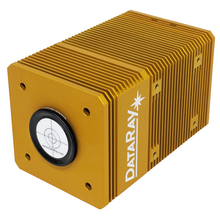
WinCamD-QD
- Options for 1550 and 2000 nm
- Large sensor formats available
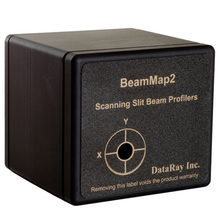
BeamMap2
- Robust, multi-plane beam profiling
- Real-time M², divergence, pointing, and focal measurements
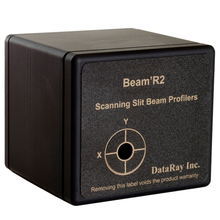
Beam'R2
- Affordable single-plane beam profiling
- Directly profile beams as small as 2 µm
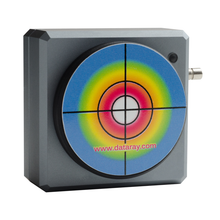
WinCamD-LCM
- Versatile global shutter supports CW & pulsed beams
- 355 to 1150 nm standard with UV, 1310 nm, and 1550 nm options

ISO 9001 Certified Company

Products Designed & Manufactured in the USA
